 Latent Equity
AI capex vs the 2000 telecom build
Our read: in 2000, internet traffic boomed but revenue didn't. Today the revenue is showing up too, just not as fast as the capex.
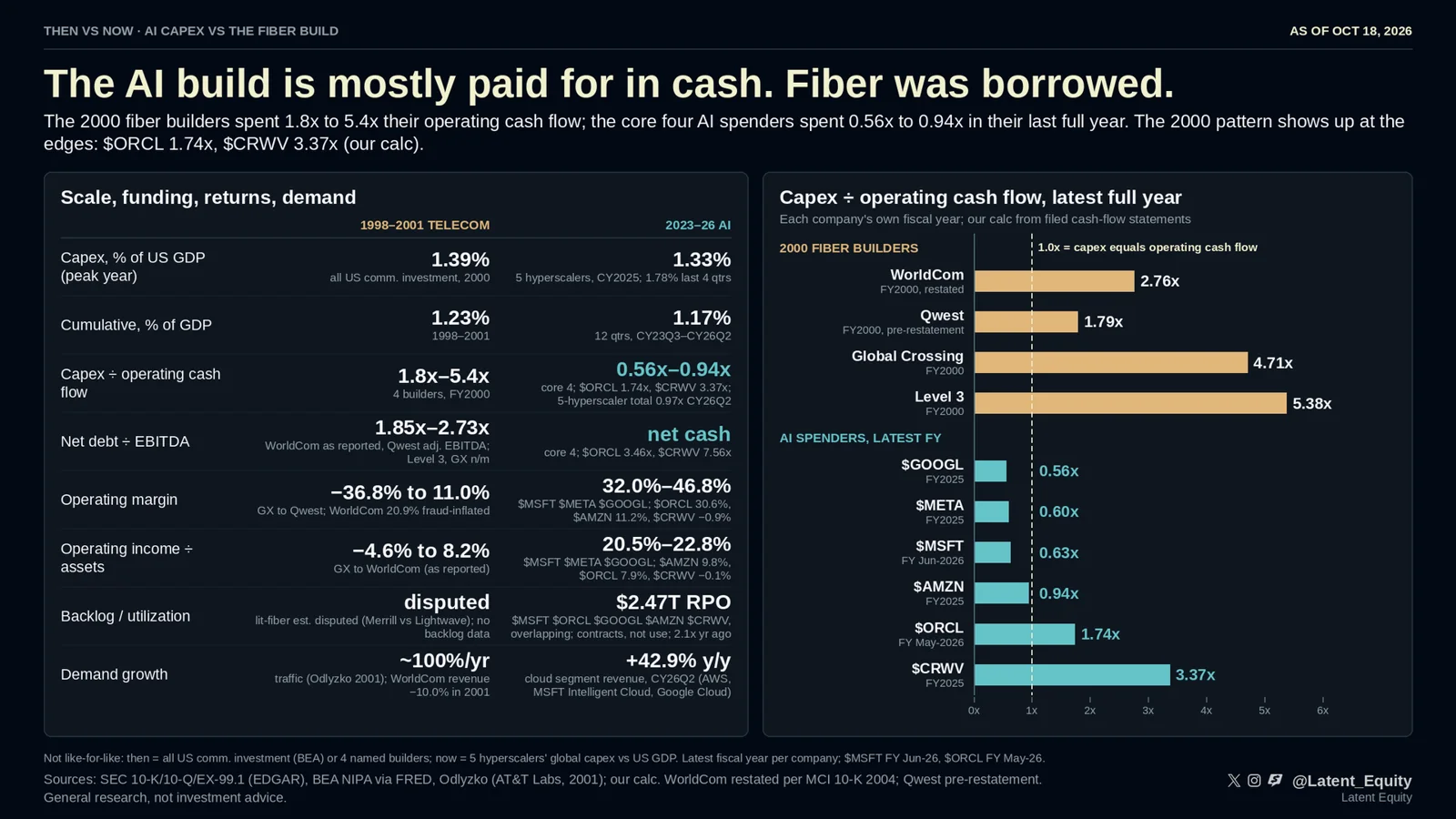
Then. US internet backbone traffic roughly doubled every year from 1997 (Odlyzko, 2003). The carriers' revenue didn't follow: WorldCom's was $35.9bn in 1999 and $35.2bn in 2001. The crash wasn't a traffic problem. It was too much building for too little revenue.
Now. Revenue is growing fast. Latest quarter, year on year: Azure +43%, AWS +37%, Google Cloud +82%, Oracle's cloud infrastructure +121% (company earnings releases). Amazon says AWS's AI business has passed a $25bn annual revenue run rate.
And the clouds say they can't build fast enough. Microsoft's CFO, July 29: "Customer demand continues to exceed available capacity." Oracle, Sept 10: AI demand "continues to grow faster than supply."
The catch. Capex is growing faster than the revenue it serves. At $AMZN, $MSFT and $GOOGL, each $1 of cloud revenue now comes with $1.27 of capex, up from $0.99 three quarters earlier (our calc). Google's API token volume rose 3.1x in three quarters while Google Cloud revenue rose 1.6x (our calc), so usage is outrunning revenue too.
Funding is where 2000 breaks. The fiber builders spent 1.8x to 5.4x their operating cash flow and borrowed the rest (our calc, 10-Ks; WorldCom 2.8x on its restated figures, 1.5x as originally reported). In their last full year, $MSFT, $GOOGL, $META and $AMZN spent 0.56x to 0.94x, and all four hold more cash than debt (our calc). The edge looks more like 2000: $ORCL spends 1.74x its operating cash flow and $CRWV 3.37x (our calc).
The cushion is thin. Free cash flow across the five hyperscalers fell from $71.6bn in Q3 2023 to $4.8bn in Q2 2026 (our calc). Their capex is now 0.97x their operating cash flow.
Q3 results start in late October.
What would prove us wrong
Set before publication. We report back in public when one trips.
- Three of the four clouds slowing for two quarters in a row. Open · next check: Q3 cloud results (late Oct; $ORCL in Dec)
- Microsoft or Oracle no longer saying demand exceeds supply. Open · next check: Q3 earnings calls (late Oct; $ORCL in Dec)
- Capex above 1.5x cloud revenue (1.27x now). Open · next check: Q3 10-Qs (late Oct; $ORCL in Dec)
- Combined capex above operating cash flow for two quarters in a row (0.97x now). Open · next check: Q3 10-Qs (late Oct; $ORCL in Dec)
- $ORCL's net debt passing 4.5x EBITDA (3.46x now), or $CRWV's operating cash flow falling short of its interest plus scheduled debt repayments. Open · next check: $ORCL 10-Q (Dec)
Method and sources
Figures marked "our calc" are our own arithmetic on the cited primary sources (company filings, earnings releases, public datasets). Every figure was checked against its source before publication.
General research, the same for every reader. Not investment advice.