 Latent Equity
Hyperscaler debt vs rates
Higher rates barely touch hyperscaler margins, with one exception: $ORCL.
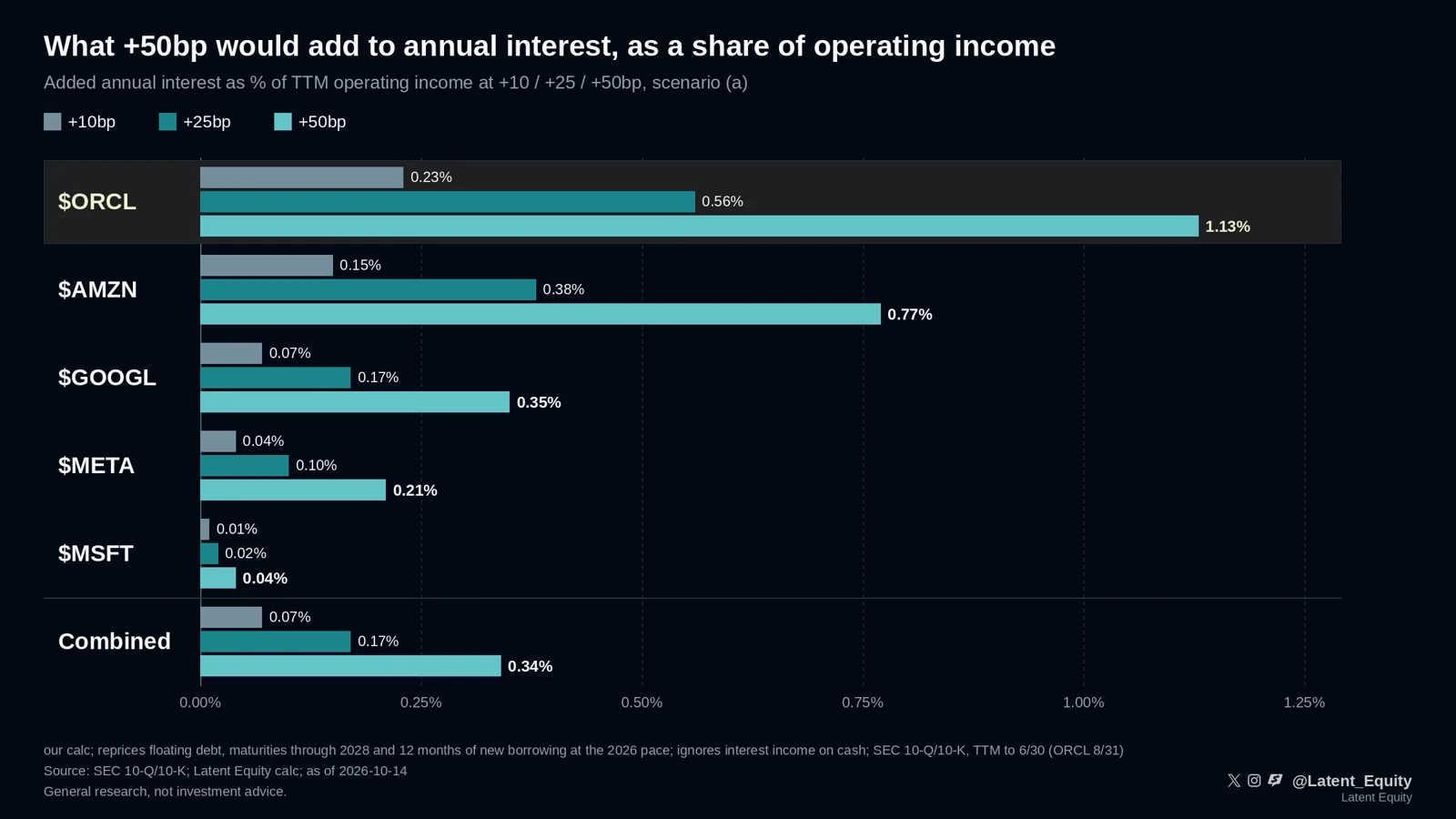
About 97% of the $489bn of face-value debt at $AMZN, $GOOGL, $META, $MSFT and $ORCL is fixed rate. Fixed-rate bonds don't reprice when rates move.
We repriced what could plausibly reprice: floating debt, bonds maturing through 2028, and 12 months of new borrowing at the 2026 pace (our calc).
+10bp adds $345M a year combined
+25bp adds $863M
+50bp adds $1.7bn, which is 0.34% of operating income, or 9bps of operating margin
Even if all of it repriced, +50bp would be $2.7bn, or 0.54%.
$ORCL is the one name where it registers. At +50bp the cost is 1.13% of operating income (36bps of margin), rising to 2.71% (87bps) if all its debt repriced (our calc).
Operating income covers its interest 4.5x, against 28–66x at the other four, and its debt is 3.7x EBITDA. Depreciation runs 11–15x interest at the other four, but only 1.8x at $ORCL.
The caveats. These numbers ignore interest earned on ~$570bn of cash and short-term investments, which cuts the other way. We haven't confirmed whether $AMZN drew its $17.5bn term loan; if it did, that would add ~$88M at +50bp.
For the AI buildout, the bigger cost is depreciation, which is up 45% from a year earlier combined, not interest.
Method and sources
Figures marked "our calc" are our own arithmetic on the cited primary sources (company filings, earnings releases, public datasets). Every figure was checked against its source before publication.
General research, the same for every reader. Not investment advice.