 Latent Equity
Library · Options fear tracker
Options fear tracker: investors brace for swings the market isn't delivering
Our read: investors are paying up for protection against big swings, but the market itself has stayed calm. The gap between the two is 9.69 points, higher than on 93% of trading days since 1990 (our calc).
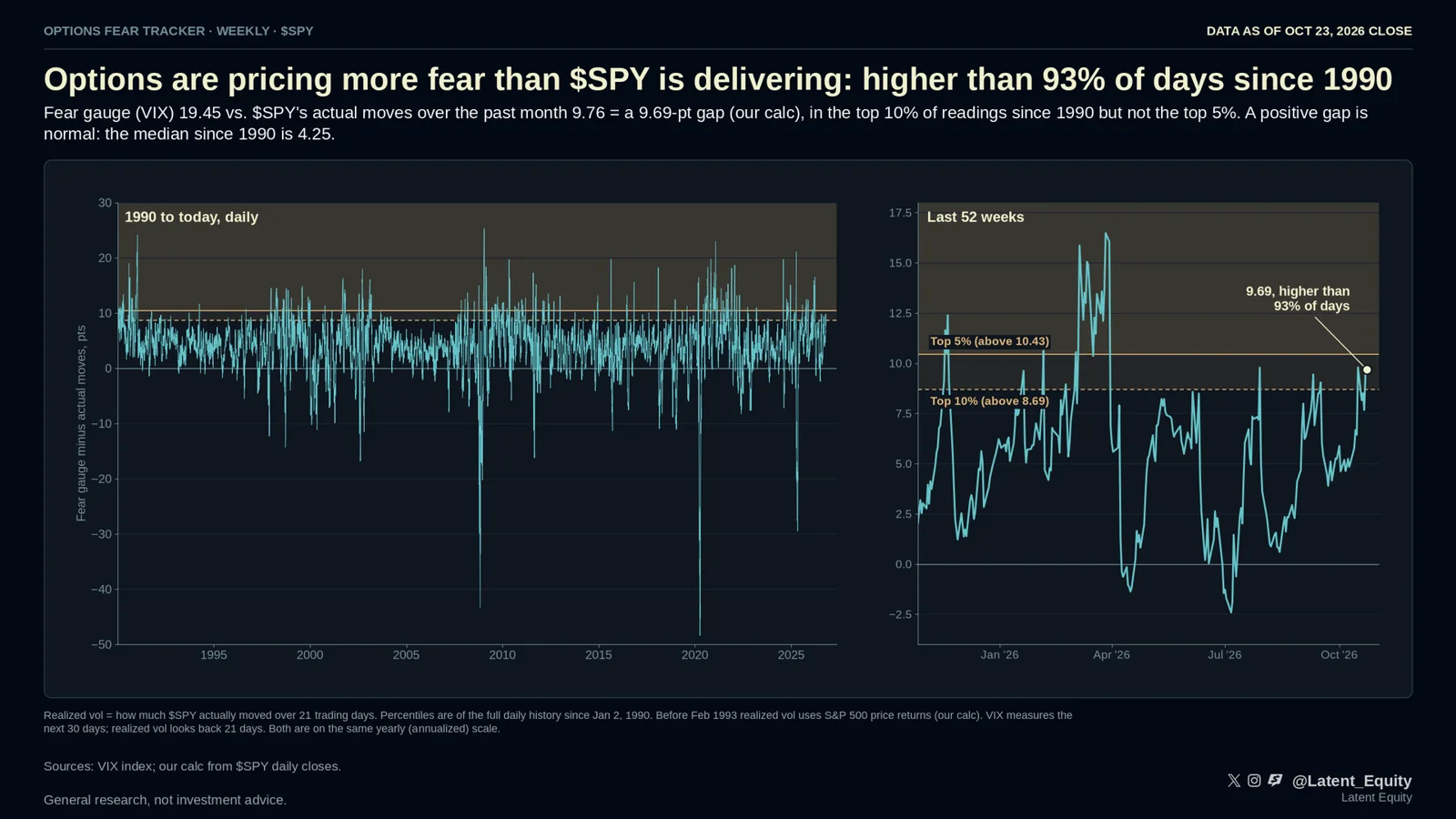
How we measure it: the VIX is the market's "fear gauge". It uses S&P 500 option prices to show how big a swing investors expect over the next month. We compare it with how much $SPY has actually swung over the last 21 trading days (about a month), on the same yearly scale. The gap is how much more movement investors are bracing for than the market is delivering.
What changed this week:
- The gap shrank to 7.67 on Wednesday, then widened again to 9.69 by Friday. The fear gauge went back up while $SPY's actual swings stayed near 10 on the same scale.
- This is the second straight week in the top 10% of readings, after a month at about 4 to 5. The typical (median) reading since 1990 is 4.25.
- $SPY closed 2.45% below its 52-week closing high (Oct 6).
What happened before in similar spots (gap in the top 10%, $SPY within 3% of its high, 42 past cases, our calc). Average $SPY move afterward, compared with all days:
- 1 month later: +1.55%, higher 76% of the time (all days: +0.95%, 65%)
- 3 months later: +3.11%, higher 76% (all days: +2.86%, 72%)
- 6 months later: +7.17%, higher 88% (all days: +5.79%, 76%)
Caveats: 42 cases is a small sample, the time periods overlap, and most of them come from after 2009. We haven't tested whether the difference is statistically meaningful.
What would prove us wrong (our read)
Set before publication. We report back in public when one trips.
- the gap closes because the market starts actually swinging as much as the fear gauge implies, not because the fear fades. Open · next check: Weekly update (next: Oct 30 close)
General research, the same for every reader. Not investment advice.
Sources: Cboe (VIX), daily closes; our calc.
Method and sources
Figures marked "our calc" are our own arithmetic on the cited primary sources (company filings, earnings releases, public datasets). Every figure was checked against its source before publication.
General research, the same for every reader. Not investment advice.